
Here is a number I use when explaining concrete to building owners: seven to fifteen years. That is the window of growth for the early warning signs of spall damage on ocean-facing decks in Honolulu. Catch the early signs inside that window with a good repair scope and you spend a few hundred dollars per bay. Ignore them and you can replace an entire slab edge, patch the slab, and still be back at the same wall in a couple of years.
I have walked parking podiums in Kakaako, loading docks in Kalihi, and storefront canopies on Kapiolani with owners who insisted everything was fine. In nearly every case, the concrete was telling a different story. What they needed was not a lecture about chemistry. They needed a decision framework. Spot the damage pattern first, then decide scope, then schedule the work around tenant traffic before someone files an incident report or a city inspector writes a citation.
Why Oahu Concrete Fails Faster Than Almost Anywhere on the Mainland
Salt and heat are the two most obvious culprits, but the bigger issue is the daily cycle. Your deck warms during the day and cools at night. The slab expands and contracts. That cycle drives hairline cracking year after year. Then salt air and wind-driven rain push chloride ions through the cracks and down toward the reinforcing steel inside. Water alone is survivable.
Chloride-laden moisture is what actually kills embedded steel.
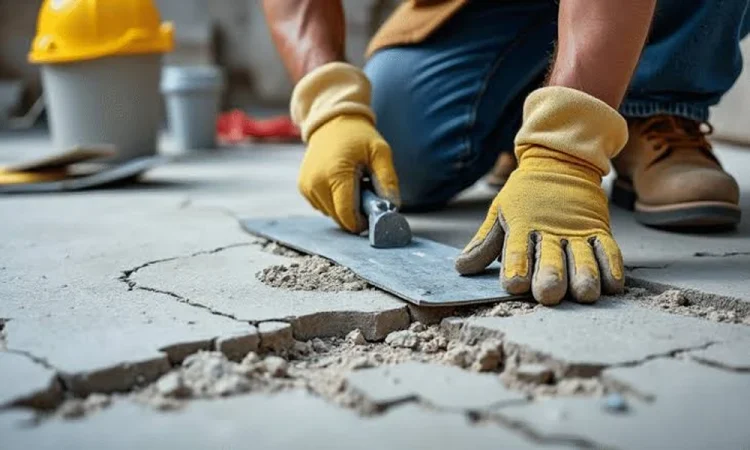
Once the steel begins to corrode, it expands in volume, pushing outward on the concrete that surrounds it. That outward pressure is what pops the surface off the bar in sheets. Professionals call this spalling. To you it looks like a crater with rust staining around the edges, sometimes with an exposed rebar sitting at the bottom like a bone.
Snowbelt cities deal with a different version of this problem because deicing salts that get tracked onto concrete in winter can create similar chloride exposure patterns, though the cold and warm cycles there are seasonal rather than daily. Honolulu gets the salt without the freeze-thaw, and the daily thermal cycling means the failure timeline compresses. If your property sits within a mile of the coastline, plan on a faster clock than anything a Hawaii-grown contractor trained on mainland playbooks will tell you. For context on how heat and moisture drive the local environment, the National Weather Service tracks the seasonal patterns and rainfall that shape coastal exposure on Oahu.
Reading the Warning Signs Before Structural Damage Sets In
You do not need a testing lab to spot the early stages. You need ten minutes and a working flashlight. Walk the property quarterly and look for these patterns:
- Rust staining in a starburst or fan pattern radiating from a crack or edge
- Hollow sound when you tap the surface with a screwdriver handle or coin (dull thud = delamination beginning under the surface)
- Map cracking forming a spiderweb of fine lines over a wide area
- Cratered or popped-out patches on the underside of elevated slabs and column bases
- Efflorescence (white chalky deposits) wet or dry along expansion joints and vertical seams
That last one is the one most owners miss. Efflorescence means moisture is moving through the concrete and leaving behind mineral deposits as it evaporates. It is a moisture pathway, not a cosmetic issue.
Why Patches Alone Usually Fail on Coastal Oahu Buildings
I have watched enough failed patches to have a theory: cutting corners on surface prep is the reason. A patching crew shows up with a bucket of premix, trowels it into the crater, trowels it smooth, and leaves. Three years later, that same patch has separated and looks worse than the original spall.
Done right, the repair sequence looks different. Break back to sound concrete with a chipping hammer, not a grinder. Get behind every bit of delaminated material until you hear a solid ring. If there is a rebar running through that area, wire-brush it or sandblast it down to bright steel. Then epoxy-coat the bar, apply a bonding agent, and place a repair mortar that is formulated for coastal chloride exposure rather than a generic bag mix. Skim-coating over the damage and calling it patched is why so many buildings look worse five years after their first repair than they did the day they started. Hiring an experienced commercial structural repair company in Honolulu usually pays for itself through scope accuracy, since a crew that knows coastal Oahu conditions won’t overscope areas that don’t need work or under-prep areas that do.
Three Scope Tiers and What Each One Actually Costs You
Most Honolulu commercial property managers face the same basic decision once the damage is diagnosed. Here is the tier breakdown I use when I talk with owners:
| Scope Tier | Typical Use Case | Timeline impact |
|---|---|---|
| Cosmetic spot repair | Isolated spalls under 6 inches with no exposed bar | Day or two per area; minimal disruption |
| Structural restorative patch | Delaminated areas with exposed or rusting rebar | Several days to a couple weeks; short closures needed |
| Full system restoration | Widespread spalling on decks, canopies, or column bases | Weeks to months; phased access plans required |
The mistake owners make is jumping straight to Tier 3 without an honest Tier 1 or 2 evaluation, or staying in Tier 1 too long because the repair is cheap. Tier 1 on a 20 by 20 foot delaminated deck area is money burned. Tier 3 on three isolated pockmarks in a planter wall is money wasted. Match the tier to the actual damage pattern.
Planning Concrete Restoration Around Tenants and Traffic
Tenant complaints about repair work almost always trace back to access planning, not to noise or dust. Concrete chipping is loud. Everyone knows that going in. What drives a complaint to the property manager’s desk is a garage entrance that is closed without warning, or a storefront walkway that is blocked during morning rush, or a loading dock that cannot receive a delivery on a Tuesday because nobody flagged the schedule.
The way to prevent this is to build the schedule around the property’s traffic map, not the contractor’s crew availability. Two patterns that work in Honolulu:
- Night and weekend windows for retail and mixed-use properties where daytime foot traffic is the primary revenue driver
- Sectional closures with posted signage a full week in advance for garages and parking structures, so drivers can adjust their routes
Before you sign a scope, ask your contractor for a written sequence that lists each closure window, the duration, and the detour. If they cannot produce that in a page, they have not planned the work.
When to Call an Engineer Instead of a Repair Crew
Not every spall is a repair job. Some are symptoms of something bigger going on underneath. Get a structural engineer involved when any of these show up:
- Cracks wider than a quarter inch running vertically up a column
- Spalling along the top or bottom of a load-bearing beam
- Visible deflection in a slab or beam when you sight along its edge
- Corrosion on post-tension cable anchors (some Honolulu towers rely on post-tension systems, and these need a specialist eye)
- Any spalling that appears in a sudden wave rather than as slow erosion over months
That last pattern is the one that worries me most. Slow spalling is expected wear and tear. Sudden spalling usually means the steel inside is corroding faster than the surface lets on, and the passive protection is already gone.
The U.S. Geological Survey maintains a public record of seismic activity for the Hawaiian Islands, and while Oahu sees far less shaking than the Big Island, older unreinforced structures are more sensitive to any ground movement. If your building predates modern seismic codes, the engineering review is worth the cost even when the visible damage looks minor. The Centers for Disease Control and Prevention also publishes guidance on silica exposure for construction work, which matters because cutting or grinding concrete without water suppression puts dust in the air where your tenants are walking.
Prevention Is Cheaper Than Restoration, Every Time
Every owner I talk to eventually asks the same question. What if we had done something sooner? Here is what actually works, ranked by effort:
- Seal new concrete surfaces within the first year to slow chloride ingress
- Re-caulk expansion joints every three to five years with a marine-grade urethane
- Keep planter drains clear and route irrigation away from any concrete edge
- Run quarterly inspections with a checklist and a camera, and log every change
- Repair small spalls at 2 to 4 square inches before they grow into 2 to 4 square feet
None of those steps is exciting, and none gets a headline. But property managers who own
Honolulu buildings for the long haul know the difference between an annual maintenance line item and a million-dollar slab repair. Concrete does not surprise you. It gives you years of signals first.
If you have been putting off a walk of your parking podium or storefront canopy, put it on the calendar for this month. Bring a flashlight, tap the surfaces, and photograph anything that looks different from the last time you looked. Your future self will thank you when the repair bid comes back small instead of large.