

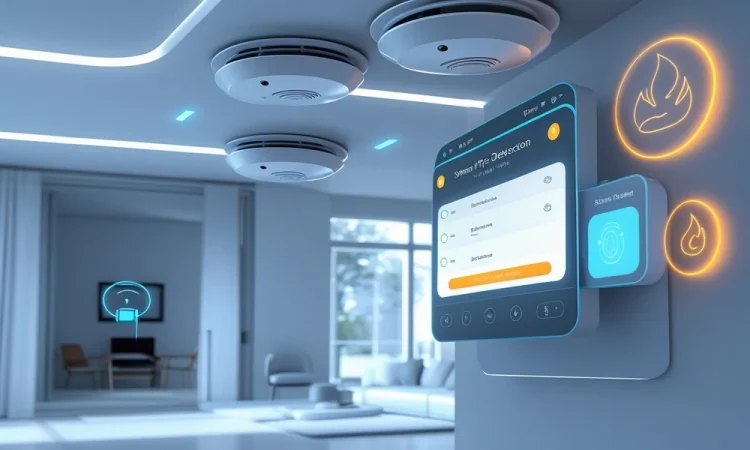
A home fire is reported in the United States every 96 seconds. That number does not come from a think tank or an advocacy group – it comes from the National Fire Protection Association’s own tracking of real incidents. And despite decades of safety improvements, the toll keeps growing. So when people say smart home automation is “just convenience tech,” they’re missing the part where it’s also quietly rewriting how fast a house can respond to flames.
The shift from a standalone smoke detector to a fully networked fire detection system is bigger than most homeowners realize. The hardware looks similar. The behavior is completely different. Here’s what’s actually changing, why it matters, and how you can think through what kind of setup belongs in your home.
The Fire Problem That Modern Tech Is Trying to Solve
Before anything else, the scale of the problem deserves a clear-eyed look. In 2024, 1.39 million U.S. fires caused 3,920 deaths and $19.1 billion in property damage. That figure covers all fire types, but the residential share is staggering. Home fires accounted for 75% of civilian fire deaths and injuries, according to the NFPA’s 2024 U.S. Fire Loss research summary published in February 2026.
What that means practically: most fire victims die where they sleep. They die in the houses they know by heart. And in most cases, the outcome changed in the first two to three minutes after ignition. That two-minute window is exactly where smart detection technology is trying to buy time.
The old model was simple. A detector senses smoke, sounds a local alarm, and hopes somebody is home and awake to hear it. That model still works. It just does not work well enough on its own for a lot of modern households.
What “Smart” Actually Means for a Fire Detector
The word “smart” gets applied to every device with a Wi-Fi chip, so it’s worth being specific. A smart fire detection system differs from a conventional detector in four concrete ways.
Remote notification. When a detector triggers, your phone gets an alert. You’re at the office, at the grocery store, on a plane with Wi-Fi. You know immediately, not when you pull into the driveway and smell smoke.
Multi-sensor discrimination. Intelligent sensors can distinguish between steam, cooking smoke, and a real fire, which reduces the occurrence of false alarms. This matters more than it sounds. A detector that cries wolf trains people to ignore it. When the real event happens, they hesitate. If an alarm regularly goes off due to a false trigger, like dust, occupants may be slower to evacuate due to distrust.
Cross-device coordination. In a networked system, one triggered sensor can wake every other sensor in the house simultaneously. A basement detection event sounds every speaker on every floor, including the bedroom with the door closed and the fan running.
Professional monitoring integration. This is the part that changes response time most dramatically. A monitored system routes the alert to a dispatch center staffed around the clock. If you can’t be reached, they call emergency services. You don’t have to be the one to make that call at 3 a.m. in a house filling with smoke.
The SEAT Framework: Four Questions Before You Upgrade
If you’re thinking about upgrading or building out a detection system, here’s a framework I’d call SEAT: Sensors, Ecosystem, Alerts, and Trust.
Sensors. What types does your current setup cover? Smoke only? Heat? Carbon monoxide? A modern installation should include all three, ideally in a single multi-sensor unit where code allows.
Ecosystem. What smart home platform are you already running? A Google Nest hub, an Amazon Alexa system, a Samsung SmartThings setup? Your fire detection should talk to the same platform so automation routines can trigger lighting, unlock smart locks for first responders, or shut down HVAC automatically when smoke is detected.
Alerts. Who gets notified, and how fast? Review whether your system calls you, texts you, emails you, or contacts a monitoring center. More notification paths equals more redundancy. For households with elderly residents or people with hearing impairments, visual alerts and bed shakers add a layer that sound alone can’t cover.
Trust. Has your system earned reliable behavior over time? A sensor that regularly false-triggers gets disabled or ignored. Calibration and proper placement are the foundation of a system people actually respond to when it matters.
Placement, Integration, and the Case for Professional Installation
The technology is only as good as how it’s installed. This is the part where a lot of DIY-first homeowners run into trouble.
Correct sensor placement follows specific code requirements – ceiling placement, distance from cooking appliances, coverage per square footage – that vary by jurisdiction. Get these wrong and your system may meet no legal standard at all, which creates real liability exposure on top of the safety gap. Professional installation is essential for safety-critical systems; correct placement, calibration, and ongoing maintenance ensure reliability, compliance, and cross-device compatibility over time, according to CEDIA, the global trade association for smart home professionals.
For homeowners in Georgia, working with a locally certified installer who understands both state fire code and smart home integration is worth prioritizing. If you’re evaluating your options, looking into fire alarm installation in Atlanta through a professionally monitored provider gives you both the technical compliance and the 24/7 dispatch connection that standalone devices simply can’t replicate.
“Multi-sensor technology better distinguishes real fires from dust or cooking smoke, meaning occupants take alarms more seriously when they do go off.”
– CEDIA, the Customs Electronics Design and Installation Association, in their 2026 smart fire detector guidance for homeowners
How Smart Home Platforms Are Changing the Game in 2026
The Matter 1.5 interoperability standard, published in November 2025, added cameras and energy management to the cross-brand protocol. That matters for fire detection because it closes one of the biggest gaps in multi-ecosystem homes: a Nest Protect, a SmartThings hub, and an Arlo camera system that previously couldn’t talk to each other can now share state data.
The average U.S. smart-home household now carries 6.2 connected devices across security, lighting, audio, and HVAC categories, with Matter standardization closing the cross-vendor gaps that previously capped multi-ecosystem installs. Fire detection slotting cleanly into that ecosystem – rather than sitting as a separate, isolated system – is the direction the whole industry is heading.
| Feature | Standalone Detector | Smart Networked System | Monitored Smart System |
|---|---|---|---|
| Local alarm | Yes | Yes | Yes |
| Remote phone alert | No | Yes | Yes |
| Cross-device coordination | No | Yes | Yes |
| 24/7 dispatch capability | No | No | Yes |
| Smart home automation triggers | No | Limited | Yes |
| Multi-sensor discrimination | Basic | Advanced | Advanced |
A Practical Checklist: Auditing Your Current Setup
- Walk every floor and confirm a detector is present in each sleeping area, outside each sleeping area, and on every level including the basement.
- Check manufacture dates. Smoke detectors have a 10-year lifespan. Many homes are running sensors that expired years ago.
- Test interconnect behavior. Trigger one detector manually and confirm that all others in the house respond.
- Confirm whether your system connects to a monitoring center or only alerts your personal device.
- Ask your installer whether your setup meets current local fire code, not just the manufacturer’s minimum spec.
- Review your smart home platform for any automation rules that should trigger on a fire event: lights on, locks unlocked, HVAC off.
The technology has advanced far enough that the gap between “adequate” and “genuinely protective” is smaller than ever to close. One- and two-family home fires account for 65.8% of civilian deaths, according to the National Safety Council’s injury data for 2024 – which means the single-family home is still the highest-risk environment. If you own one, that checklist above is not optional reading.
Smart home automation did not invent fire safety. But it has made the response chain faster, the alerts more reliable, and the integration with emergency services tighter than anything a battery-powered standalone unit can manage. That’s the real change – and it’s worth taking seriously.